Showing posts with label #celltherapy. Show all posts

Monday, January 4, 2016

Cell therapy blockbuster or safe and cost effective supply chain?

By Fabio D'Agostino

The golden opportunity of a blockbuster (drug selling more than $1bn per year) might have to be revisited for many Big Pharma and SMEs which invested in cell and gene therapy development. Given the pressure due to patents expiring and biosimilar competition, this should sound as a massive relief. This is probably due to the fact that these products, arguably more than other drugs, were born in University Research centres and therefore the focus has been on development. Bio-preservation has been regarded as a trivial afterthought. Not many developers seem to pay much attention to stability studies which are paramount in order to design and develop the best supply chain option for the product. As the industry moves from scientific curiosity to sustainable commercialization, we know that preserving viability and potency of cell based products is anything but simple. If for vaccines and monoclonal antibodies, store and transport at 2-8 ⁰C is enough to preserve the product for 18 months or even more, it is not that simple for cell based products. Bio-preservation strategies will depend on cell type, temperature, excipients, primary container (materials and shape). There are mainly 3 bio-preservation methods for cell therapy medicinal products:
-          Controlled ambient temperature:  15-25 ⁰C, limited shelf life
-          Hypothermic storage : 2-8 ⁰C, prolonged shelf life but normally requires addition of protective agents ( like HypoThermosol, BioLife Solutions)
-          Cryopreservation: - 80 ⁰C or below. It requires addition of toxic cryoprotectants (like DMSO) which protects cells from ice crystals forming during cooling.

Because it normally enables the longest shelf life for the cell-therapy products, cryopreservation is often regarded as the gold standard or rather the “hoped” standard. Although it potentially equates to a more stable product, the costs associated with dry nitrogen shipping and storage may encourage developers to look at -80°C or even -20°C (should stability data allow these temperatures). Cheaper storage and shipping fees will lower cost of goods. 

Another influencing factor for the storage conditions of the product could also be the nature of the illness being treated. Acute illnesses being treated by autologous therapies may not require long term storage of product if the therapy is genuinely curative in nature. Furthermore, not every cell therapy product can be effectively cryopreserved (with currently available technology and methods). 

World leading research groups have proved and disproved the potential negative effect of cryopreservation on the therapeutic effect of cell-based medicinal products. Many readers will agree there are so many variables to take into consideration that perhaps nobody will ever be able to confidently state that cryopreservation is safe and effective to use for cell-based products. It might affect a particular mechanism of action while being completely innocuous for others. Therefore, the key concern for developers should be to validate a relevant potency assay and get the stability data necessary to design the best bio-preservation option on a case by case basis.

Here is a list of marked cell-based products, how many of them are cryopreserved?
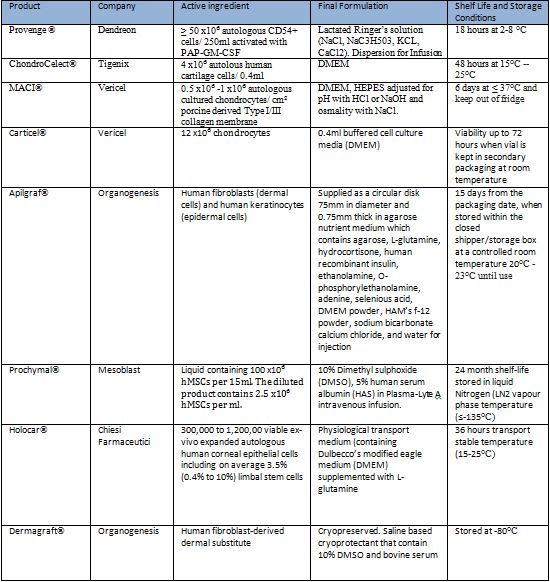


However, preserving viability and potency is only the first step. For both autologous and allogeneic products, there are three key points to consider: 

§  Safety: Full traceability of the entire supply chain, from donor to patient.

§  Scalability: Operations should be designed in a way to manage an increasing number of patients, from 1 per week in phase I to 10 or more in Phase III and commercial stage. If Novartis hopes to launch its CTL019 in 2017, this might translate in as many as 200 patients per week.

§  Flexibility: This is important for both the company and the patient. The former needs to coordinate with the hospital when to ship the product and the latter, who might often been seriously ill, has too travel to the hospital on a set day.


It is the first time in history that big pharma company or SMEs have to design a more service-based model than a product-based.  For a physician and for the patient, what will ultimately matter is that the drug does the trick, especially for life threatening diseases.  As we move towards a more individualized medicine, one might envision that pharmaceutical companies will make more profit from the service they provide than from their products. Many industries have already witnessed such paradigm shift. Companies like TrakCel are leading the way in proving cell and gene therapy manufacturers with the tools to deliver the right product to the right patient at the right time. 

According to TrakCel, costs can also be reduced by maximizing the available assets and optimizing headcounts necessary in the supply chain. For autologous products, where two procedures are necessary, it will be possible to collect the sample from the patient in a hospital nearby and limit the travel to a specialized hospital for the treatment with the finished product. More flexibility will also come from a longer shelf life. Shelf life as short as 18 hours are not commercially viable for large patient populations. Even by using specialized express couriers, the risk of failure linked to scheduling can be very high. More innovative ways to increase the length of the shelf life are under development. Research groups are even going as far as lyophilize the product. 

So far it has been mainly applied to red blood cells preservation. If this will ever be possible with other cell types, it can be a game changer in the industry. Nurses and doctors could easily re-suspend the product as they are used to doing with more conventional drugs, but perhaps this is a topic for another blog post. 

Fabio D’Agostino is a passionate life sciences professional with experience in both the medical device and biopharmaceutical industry. An active member of the PDA Cell and Gene Task Force, he has contributed to a number of conferences in the cell and gene therapy industries. He was also instrumental in the launch of the new journal: Cell and Gene Therapy Insights.
After graduating with Honours from the Polytechnic University of Turin (Italy) with a BSc and a Master’s in Biomedical Engineering, he started his career at LivaNova (formerly Sorin Group) before moving to Newcastle University to take an Engineering Doctorate in Biopharmaceutical Process Development. He currently holds a research position at the Institute of Genetic Medicine (Newcastle University) where he is responsible for the development of an innovative platform for modular tissue engineering.


Share this article with your social network, just click below to share now!


Monday, November 2, 2015

Cell Therapy Manufacturing Best Practices from PCT


This article is the second in a series of weekly posts featuring cell therapy news and articles as reported by BioProcess International Magazine. 


By: Leah Kinthaert

In the October 15 issue of BioProcess International, a group of industry thought leaders consisting of Bob Preti, Ann Daus, Cenk Sumen and Brian Hampson from PCT - Caladrius were asked to give their opinions on the most successful strategies for manufacturing in the cell therapy industry.

Best practices for commercial cell therapy manufacturing
The team states that implementing DbD or Development by Design, consisting of these facets: quality, cost of goods, scalability and sustainability (picture above), will "provide significant cost and time advantages as a cell therapy moves along in its clinical process".

Compliance at cell therapy manufacturing facilities
A foundational state of compliance entails that people, facilities, systems and processes are unified in compliance, and that a QTF or quality task force is created  which includes "representatives from manufacturing, operations, and quality groups, with different areas of industry experience." They caution cell therapy developers not to wait to worry about quality until something has gone wrong - such as delays or regulatory actions - but to have the QTF in place from the beginning.

Develop QTPP early
The team gives another strong message about preparation when it comes to QTPP or quality target product profile. As with QTF, waiting to develop a QTPP can lead to problems.

Strategic Commercial Manufacturing Plan
One last acronym they recommend is a SCMP or strategic commercial manufacturing plan. Keeping with the theme of planning the future to avoid potential problems, a SCMP needs to include: "an evaluation of a developer’s current manufacturing processes; an analysis of those processes for areas of potential optimization and improvement; and a practical, implementable strategy to take a process from its current state to a future, commercial-ready state while reducing risks." You can read the entire article here.

PCT - Caladrius in the News: 
In his opening remarks at the BioProcess International Conference Cell Therapy Pre-Conference Symposia, Chairperson Kurt Tisler showed a map of the US with a handful of companies on it. The map included "Cell Therapy CMO Options in the US" and PCT was one of only 3 private companies and another handful of institutions that were options for Phase III in cell therapy. The map gave a striking picture of just how much those companies are in the forefront of cell therapy manufacturing. The past two months have been eventful for this industry leader, with news on multiple fronts. What follows is a brief run-down of noteworthy news about this organization.

PCT supporting IRX's development of IRX-2
PCT is providing IRX "with personnel and dedicated clean room capacity within its current cGMP infrastructure and pursuant to EU cell therapy manufacturing standards.” Caladrius is the only cGMP-compliant cell therapy manufacturing provider that has facilities on both the East and the West Coasts. Additionally they are the only one to see a client's cell therapy product receive approval from the FDA for commercial sale.

PCT has entered into a collaboration agreement with Sanford Research to develop CLBS03
The initial focus will be the execution of a clinical trial to evaluate the safety and efficacy of CLBS03 in adolescents. The Phase 2 study has an open and active IND; subject enrollment is expected to commence the first quarter of 2016.

NIH's National Cancer Institute gives $300K in funding, with a potential $2 million to follow
This will fund the first phase process optimization of Caladrius' therapeutic agent targeting tumor-initiating cells. The $2 million in funding is to be expected in June 2016 if both the government and Caladrius agree to proceed at the conclusion of the first phase.


Share this article with your social network, just click below to share now!


Wednesday, October 28, 2015

Start-Up of the Week: Semma Therapeutics


This article is the first in a series of weekly posts that will look at cell therapy start-ups that are making headlines. 


By: Leah Kinthaert

At the Cell Therapy BioProcessing Pre-Conference Symposia for the BioProcess International Conference and Exposition, Chris Gemmiti of Wyss Institute, in his "State of the Industry" talk brought up six companies who have received funding this year. His list included Semma Therapeutics, a company who was all over the news back in March when they closed a $44 million series A funding round.

What has Semma Therapeutics been up to since March?
Semma Co-Founder and CEO Robert Millman recently spoke at BioPharm America where he gave some incredible insight on the choices he and his organization have made in regards to partners, manufacturing and other strategic goals.

Millman discusses the two hats he wore, in acquiring funding for Semma.  As CEO... "I want non-diluted financing, I want a strategic partner...I don't want to be in a situation where I need data and have to go out to reraise capital. I need a partner who's committed."

Millman continued: As VC... "I want to reduce risk, reduce cost basis of my investment, pre money evaluation”. Millman explains: "The intersection of a wants of a biotech company, and the wants of a venture partner came together ...in the funding of Semma.”

Semma Therapeutics has partnered with Novartis and Medtronics, a company which has a multimillion dollar business in diabetic pumps. Why a company that makes pumps is suddenly interested in cell therapy says a lot about how cell therapies are shaking up the healthcare industry. Millman explains: "If cells work better than pumps that industry goes away."

How Semma came to be: 
"Semma Came together very quickly once Doug Melton (scientific founder of Semma) committed that he wanted to do this not through a strategic relationship with a single pharmaceutical but wanted to incubate it with a biotech, because a biotech company can really progress things faster and it also leaves a lot of incentive on the table for the founding and the founding institution where a direct license to a pharmaceutical company may not. The goal of Semma was to raise enough capital to move it to a point of strategic advancement, but remain enough leverage on the table so when you got to that next point of value creation and had a need for another raise it would be at a high incremental value."

Millman has had several years of experience in biotech, and has some specific theories as to why some cell therapy companies have failed: “In my career I watched a lot of biotech companies fail because the CEO at the time said ‘Look I’m smarter than pharm, I am going to keep this agent and move it farther down the stream' and that’s where the problems typically happen.“

Explaining why Semma opted to choose Novartis as a partner: 
“When a pharmaceutical company wants something it will put more resources than any biotech company can put on something to move it over the hump. It’s an amazing relationship when pharma really wants what you’re working on.” Millman does, however, seem to understand why some start-ups are hesitant: “The downside of bringing in a strategic partner in the beginning is that you’re almost like captured bait”...“Some VCs will say that’s a bad model because I want to go out and hit the free market later.”

On Semma's decision to not build their own plant:
"What happens is you spend $100 million on facility infrastructure and maintenance cost for a product that you don’t even know is there. You control the process, but that is not always the best way to go forward. The investment in time to get a plant up, get ready for manufacturing...adds about a year and a half to a minimum of two years on my timeline. Renting that will triple my costs on the front end for that single per gram basis, but over the long run I think it's a better investment for us.”

Semma's biggest hurdle: 
“Our cells need to come together for the general population with a device... a delivery technology. The goal here is treating patients, how do I get what I have for patients. In my in my case I need delivery and delivery technology to access a very large patient population.”

A lot is at stake for Semma right now. As Chris Gemmiti, speaking this week at BioProcess International commented: (They got) "$44 billion in funding and they're not even at the IND stage." All eyes are on Semma as they attempt to bring their technology to the clinical stage.

Click here to watch the full panel discussion with Robert Millman of Semma at BioPharm America last month.


Share this article with your social network, just click below to share now!


Monday, October 26, 2015

Update on Japan's New Cell Therapy Regulations


By: Leah Kinthaert

At the Cell Therapy BioProcessing Pre-Conference Symposia for the BioProcess International Conference and Exposition, VP of Business Development for RepliCel and cell therapy industry thought leader Lee Buckler updated the audience on Japan's new cell therapy regulations. Buckler was a great person to give insight into these new regulations, because RepliCel is partnered with a Japanese company.

The regulatory environment for cell therapies changed greatly in 2012 when Shinzo Abe was elected prime minister. Last year Abe (who has since then been re-elected) set a plan in action to change the existing regulations and provide $1 billion in stem cell research funding over the next 10 years. This political and economic driven regulatory innovation has created a market push into Japan; Buckler described how his company re-prioritized Japan into their strategy due to this seachange.

Japanese companies are actually getting overt recommendations from their government to go into cell therapies; the government has incentivized companies to locate in Kobe, where the Kobe Biomedical Research Center is located. Buckler stated: "One can't underestimate the power of government to influence corporate decisions. CEOs feel the need to respond to government presence."

Buckler went on to give details about his company RepliCel's research in Japan. RepliCel has partnered with one of the world's top hair care and cosmetics companies, Shiseido. Shiseido has built their own manufacturing facility in Japan, making RepliCel one of just two companies with a cell manufacturing footprint in Japan.

Buckler ended his lecture by asking the audience to ponder this question: "Over the long term, will it (changes in Japanese regulations) have real lasting commercial implications?"

The agenda for the PreConference Symposia on Cell Therapy Bioprocessing on Monday, October 26 can be found here.


Share this article with your social network, just click below to share now!


State of the Cell Therapy Industry 2015: Approvals, Funding and the Future


By: Leah Kinthaert

At the Cell Therapy BioProcessing Pre-Conference Symposia for the BioProcess International Conference and Exposition, the packed room was treated to two "Where are we now in cell therapy" analyses which gave an excellent examination of the current state of the industry, and provided predictions and suggestions for a successful future.

Kirk Trisler, Principal at Dark Horse Consulting, opened the event with an extensive overview of the current landscape in cell therapies, going through cell therapies that have been approved and examining who the players are for cardiology, oncology, neurology, diabetes, and opthamology.

Tisler presented two helpful maps, one showing "Cell Therapy CMO Options in Europe" the other "Cell Therapy CMO Options in the US". The US map showed that the "only options for Phase III" in the US are WuXi, Lonza, PCT (one in CA, one in NJ), UC Davis, Temple, Stanford, City of Hope, and U of Iowa.

Tisler then went through a list of all cell therapies that have been approved. They are: Provenge by Dendrion; Lavir by Fibrocell; Holoclar by Chiesi; Chondrocelect by TiGenix; Carticel by Genzyme/Vericel; and Apligraf, Dermagraft and Ginutiut all by Organogenisis.

Chris Gemmiti, Business Development Lead, Wyss Institute - whose discussion was titled "State of the Industry - From Fund Raising to Partnering to Adoption and Commercial Success" - continued on the track of giving an overview for the current cell therapy space. He said that there has been over three billion dollars in federal funding for regenerative medicine over the last three years. Financing for cell therapy companies in the first half of this year alone is over seven billion dollars, with an additional eight billion in milestone payments.

Gemmiti then went on to talk about the companies who have been funded this year: including Semma, Voyager, Dimension, Unum, Regenxbio, and Audentes. "Look at Semma," he said "(they got) $44 billion in funding and they're not even at the IMD stage."

He continued with more helpful stats:
  • There are 580 regenerative medicine companies worldwide
  • There are 72 approved products
Gemmiti closed his presentation by cautioning the audience: "Market caps are great but they have to translate to revenue in the real world...Just having approvals and a large market cap doesn't mean commercial success."

The agenda for the PreConference Symposia on Cell Therapy Bioprocessing on Monday, October 26 can be found here.


Share this article with your social network, just click below to share now!


Friday, October 23, 2015

Innovations in Single-Use Technologies: Mario Philips of Pall


By: Leah Kinthaert

BioProcess International Magazine had a great interview with Mario Philips, President, Single-Use Technologies at Pall Life Sciences, earlier this year. Pall is the sponsor for the Cell Therapy Bioprocessing Pre-Conference Symposia at the BioProcess International Conference and Exhibition happening Monday, October 26 in Boston. What follows are some of the highlights of the conversation between Philips and BioProcess International Magazine’s Publisher Brian Caine.

In some ways, you could say Mario Philips’ career came full circle when his company entered the cell therapy market. A chemical engineer by trade with some time spent in the biopharma industry, the 2000s found him working in the semiconductor industry at a company called ATMI. Philips said: “The semiconductor industry was facing the challenge of molecular and particle contamination when cleaning the stainless steel containers used for transportation…So we developed a bag-in-a-bottle and a bag-in-a-container system.” A friend gave him the idea to translate what they were doing to the life sciences. So he set out to become the leader in SUT (single use technology) by asking customers what was not yet addressed by the current technology. The connection with cell therapy comes from the fact that Belgium, where he lives, has a comparatively large biotech industry. Not many equipment manufacturers saw cell therapy as a promising business model - but his company at the time did.

Philips brings that thought leadership and innovation to Pall, where his goal is to bring cost-effective technologies that help “companies get more out of their R&D related technologies and help them either scale out (for autologous therapies) or scale up (for allogeneic therapies).”

Caine asked Philips to describe exactly what making those technologies cost-effective would entail: – “For autologous therapies…the goals are to close up the process and develop industrial scale automation…For allogeneic therapies…the goals are to close up the process, reduce the risk, and bring in some controls.”

Caine then asked why Pall was entering the cell therapy market when so many other companies are waiting for a return and “a bit more clarity in the market”.– Philips’ responded: “At Pall we believe it is a risk, but it is a more calculated risk, and we want to be first-to-market with this platform.”

Caine: Where do you see yourself as a leader in the cell therapy market and what products does Pall have to support that? Philips answers: “I think we have a strong position in what I call the expansion step of the cells. We have more product development in what I call the volume reduction step. Then we want to leverage expertise from our current business – one such area is process development....The second area that we want to leverage is our internal biopharma automation and process group. We build large chromatography skids. We set up complete single-use suites with the bioreactor in the middle and the mixers around it. We are building the expertise to connect these great products into a real platform solution. So I would say our focus is currently on industrial manufacturing, helping customers out of a relative crunch that they are in.”

The agenda for the PreConference Symposia on Cell Therapy Bioprocessing on Monday, October 26 can be found here. You can find the complete interview with Philips here.


Share this article with your social network, just click below to share now!


Wednesday, October 21, 2015

"Think Beyond a Single Batch" says Nick Timmins' of CCRM


By: Leah Kinthaert

On October 26, Nick Timmins, Director of Product and Process Development at CCRM returns as a speaker at the BioProcess International conference in Boston. For a preview, here's a brief recap of the highlights from his half hour discussion at the recent Cell Therapy Bioprocessing & Commercialization event held just a few weeks ago in Alexandria, Virginia. The title of Timmins' lecture was: "Solutions to Process and Technology Bottlenecks."

Process Bottlenecks and Technology Gaps – Timmins started his talk off with the pronouncement that he should call his lecture "Process Bottlenecks and Technology Gaps".  He explained: "We tend to throw the term bottleneck out there without really using it in the right context, at least not the context that is formally taught, an engineering-type context." If you have a technology gap "you need to create a new solution. If you have a bottleneck you can always add more capacity, up to certain limits."

Bottlenecks can cause an accumulation of inventory – The beginning of Timmins' talk focused on defining bottlenecks in cell therapy. He describes one of the major pitfalls of a bottleneck: "If you spend a whole lot of effort running at maximum capacity, you're going to get an accumulation of inventory. Inventory costs money. In our case (cell therapy) inventory is often labile. Cells sitting in a hold step...is doing bad things to your cells."

Think beyond a single batch –  Timmins cautioned his audience "to think beyond a single batch" because "as we move beyond commercialization and industrialization, plant and equipment utilization becomes very important" and a "major component of costs."

About Nick Timmins – Nick received his PhD in Chemical Engineering from The University of Queensland, Australia, specializing in novel methods and applications for 3D multicellular spheroids. Nick is the Director of Product and Process development at CCRM. Nick’s previous work experience includes Team Leader, Cell Therapy for the Australian Institute for Bioengineering and Nanotechnology (AIBN) at The University of Queensland. In this role Nick was responsible for the bioprocess development for clinical scale manufacture of blood products from haematopoietic stem cells and process scale-up and automation of mesenchymal stem cell manufacture. Prior to this, Nick completed his Postdoctoral Fellowship at the Tissue Engineering Laboratory, ICFS at the University Hospital Basel in Switzerland where he designed and developed a bioreactor for 3D cell culture and tissue engineering, a joint industry/university project.

Timmins will be speaking at the PreConference Symposia on Cell Therapy Bioprocessing on Monday, October 26. More information can be found here.


Share this article with your social network, just click below to share now!


Monday, October 5, 2015

CGMPs essential for commercialization of cell therapy products

 Cell Therapy Bioprocessing & Commercialization attendees heard from a range of speakers on getting treatments to market


By Leah Kinthaert

Novartis's Knut Niss shared his insights
 FDA biologist Moe Heidaran PhD told attendees on the closing day of Cell Therapy Bioprocessing & Commercialization about the benefit of current good manufacturing processes (CGMPs) in the commercialization of cell therapy treatments.

Heidaran told a rapt crowd: “Efficacy of a product can be readily established if a product can be manufactured consistently with the highest quality.” He explained that, along with CGMPs, “in-depth knowledge of product is needed for high-quality product manufacturing”.

He stressed that quality control is the “most important part of CGMPs”.  “Becoming CGMP compliant is a process,” he said, adding: “It is never too early to plan.” Heidaran told the audience to be stay up to date with the FDA’s ICHQ6B guidance.

Heidaran moved on to focus on process change. He noted: “Process change is inevitable and not all of it is planned.” He said that, for a major process change, the FDA needs an amendment, while minor changes can be documented in an annual report. If unsure, a CMC reviewer could advise if a change was major or minor.

He described the time sensitivity of reporting changes: “Post licensure reporting categories have a time limit of four months if they are PAS, while the timeline for review is six months if they are in the category of CBE or CBE-30.” He told the audience they should refer to ICHQ5E for more information and said there was the potential for either clinical or non-clinical data to be required.

Heidaran affirmed the importance of the FDA’s established controls for cell therapy products, explaining their value in his closing remarks: “Change is inevitable, it’s the most critical part of product improvement. Innovation is coming into the cell therapy market, manufacturing is becoming a huge issue. Controls are not designed to be troublesome or obstructive, but to allow you to recognize challenges you have to meet to have a success strategy for commercialization.”

Join the conversation on Twitter by following #IBC_CTB15


Share this article with your social network, just click below to share now!


How to make a cell therapy product commercially successful

 Cell Therapy Bioprocessing & Commercialization attendees heard from a range of speakers on getting treatments to market


By Leah Kinthaert

Novartis's Knut Niss shared his insights
 “I have been coming here since the beginning of this event, and enjoy being in a room with a group struggling with the same questions and problems,” Novartis senior technical project leader Knut Niss told attendees on day  three of Cell Therapy Bioprocessing & Commercialization 2015.

“Five years ago we were discussing Phase 1, today we have much more advanced discussions; we have moved from discussing Phase 1 to commercialization,” he said.

Having worked with Pfizer, Novartis and Biogen, Niss shared his invaluable insight into building teams at these organizations. “When people think about what success in cell therapy would look like, they answer ‘getting to the market’. For me, success is being successful in the market,” said Niss.

Describing the challenges of having a cell therapy product on the market he said: “Once you are on the market you are out of your controlled environment. [With commercialization] you need to continue to pay attention and follow the standard operating procedures.”

He detailed what some of that uncontrolled environment might entail. “A healthy donor will be very different from the patient,” he said, giving an example of how a donor might take an occasional aspirin while the patient will have potentially taken a great deal of prescribed drugs. “Be prepared for that,” he warned. He continued: “Often you cannot use the patient’s material as a process development tool. Until you hit the clinic (you only have access to) donor material.”

Niss challenged the audience to ask the question “Is this process sustainable in the marketplace?” and advised: “CMC is a critical part of clinical development. It is important that the clinical team understands CMC and vice versa. You want to build the right team; cell therapy is very different from what they usually experience.”

Join the conversation on Twitter by following #IBC_CTB15


Share this article with your social network, just click below to share now!


Friday, October 2, 2015

How Novartis leveraged its size to transition to commercialization


Keith Wonnaccott, Novartis
By Leah Kinthaert

Novartis director of regulatory affairs, gene and cell therapy unit, Keith Wonnaccott PhD explained to a packed room at Cell Therapy Bioprocessing & Commercialization 2015 how his organization was able to leverage their company’s large size to make the transition from an academic to a commercial manufacturing environment.

Wonnaccott described how moving from University of Pennsylvania’s facilities to Novartis’s Morris Plains site was fraught with challenges. “At University of Pennsylvania we have the donor on site, the manufacturers on site, administration on site. There is no site variability or difference in medical staffs. Once we begin to transition to commercial there are many administrative sites, many collection sites,” he told attendees.

To prepare for global development and all that comes with global manufacturing, Novartis applied what Wonnaccott described as the “tech transfer process”.  “With our step-wise tech transfer process, we can transfer all the knowledge needed to perform a given process from the transferring site to the receiving site,” he said.

Wonnaccott explained what the four key goals were needed to enhance the tech-transfer process: enhancing compliance, scalability, wide-scale distribution and process optimization.

He then went on to give reasons why the tech-transfer process was so crucial. “There is more scrutiny given to late-phase clinical trials,” Wonnaccott continued. “With early phase clinical trials you need to worry about safety, but with late-phase trials your concerns become safety and efficacy.”

He added: “University of Pennsylvania has only the US requirements, we wanted to appeal to a global market.” His discussion moved on to the list of different requirements in different countries. The group learned that not only are there different standards in the US and UK, but that the EU has an additional group of standards, and then you can add to that MHLW and ISO standards.

“All these different people are defining standards for you, it’s quite the challenge,” he said.

Wonnaccott then explained how to show comparability, one of the key needs faced with transitioning from an academic to a commercial environment. He joked about the vague answer that the FDA gives when asked “What does it take to show comparability?” (“It depends”) and went on to say “There must be robust product characterization, established assays, process consistency, predefined acceptance criteria and statistical analysis.”

Wonnaccott closed his presentation with an important point: “In the face of regulatory uncertainty, good science will make for successful development. We should do what’s right for patients.”

Join the conversation on Twitter by following #IBC_CTB15


Share this article with your social network, just click below to share now!


Equipment and resources are the key Bottlenecks in cell therapy commercialization


Nick Timmins PhD

In the final session of day two at Cell Therapy Therapy Bioprocessing & Commercialization, Nick Timmins PhD, director of product and process development at the Centre for Commercialization of Regenerative Medicine, told attendees that the key bottlenecks and technology gaps in bioprocessing and commercialization of cell therapies are centered around equipment and resources.

He said that while each had different reasons for occurring and different solutions, each delay and prohibit your outcome. “The ideal pathway would be two parallel lines that increase in profits and production,” he said.

Timmins referred to three main issues in technology that often present themselves; connectivity, automation, and data capture & use. “These major gaps in the process are difficult to implement a solution for and require detailed thought out execution,” he said.
As he continued to explain different scenarios and cases of how bottlenecks and technology gaps have prohibited growth, Timmins concluded his talk with two major takeaways:
One; think beyond a single batch – industrialization, plant and equipment utilization, and theory of constraints.
And two; discriminate between bottlenecks and technology gaps – they are different things with different answers, they also have a different cost vs benefit analysis that needs to be taken into account.

Join the conversation on Twitter by following #IBC_CTB15


Share this article with your social network, just click below to share now!